


The short answer
A late payment does not automatically rule you out of a mortgage. An older credit-card late payment and a recent missed mortgage payment face different scrutiny—and sometimes different eligibility rules. Before you reapply, find out which account caused the denial and whether the obstacle is your credit score, a loan-program rule, or the lender’s own restriction.
First, identify the payment that stopped the loan
“Late payments” is not enough information to decide what to do next. Read your denial notice and ask the loan officer which account and month caused the problem. You need the payment history the lender actually reviewed, not just the score displayed in a credit app.
If the denial relied on a credit report, the notice should identify the reporting company. You can request a free report from that company within 60 days of the notice.
Write down these five details
- Account
- Was it a credit card, car loan, student loan, or mortgage?
- Month
- When was the payment reported late?
- Severity
- Does the report show 30, 60, 90, or more days past due?
- Pattern
- One late payment, or several months or accounts?
- Status now
- Is the account current, still overdue, or reported incorrectly?
Which late payments matter most?
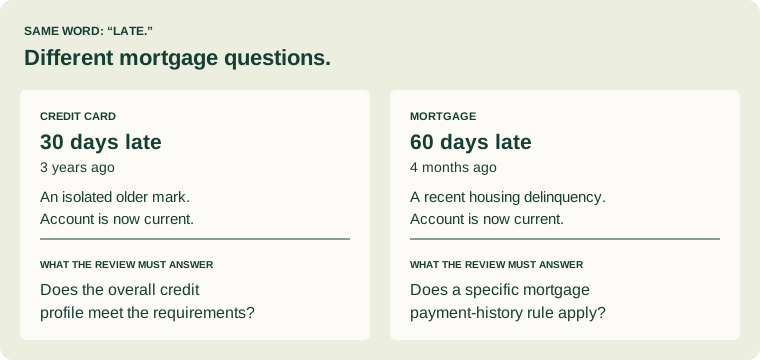
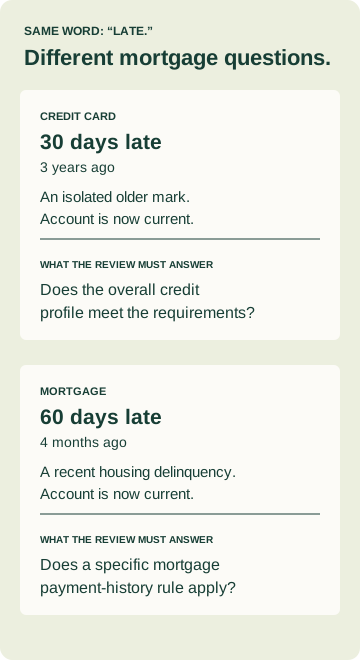
Recent and repeated missed payments raise more concern than an isolated older one. Fannie Mae specifically asks lenders to assess how recent, serious, and frequent the delinquencies are. It also notes that late payments within the recent credit history pose more risk than those more than 24 months old.
That is an assessment of risk, not a universal instruction to wait two years. The type of account can also trigger a separate rule.
Sources: Fannie Mae: payment history · Fannie Mae: previous mortgage payment history
One 30-day late payment: does it mean you cannot qualify?
No. One 30-day delinquency is not automatically a disqualification under every mortgage program. Its age, the account involved, your other payments, and the rest of the application still matter. Ask whether the lender rejected the payment history itself or whether the late payment reduced your score below its requirement. Those are different problems.
A late fee is different again. Creditors generally report a payment as delinquent to the credit bureaus once it is at least 30 days overdue; a fee can arise sooner under the account terms. Check the report rather than assuming a fee means you have a reported 30-day delinquency. Lenders can also review payment records beyond the credit report.
Sources: Fannie Mae: payment history · Experian: when a payment is reported late
A recent late mortgage payment has a specific rule
For a loan being delivered to Fannie Mae, a mortgage account showing a 60-, 90-, 120-, or 150-day delinquency within the 12 months before the credit report date makes the loan ineligible under its excessive-mortgage-delinquency rule. The existing mortgage must also meet Fannie Mae’s current-payment requirement when you apply.
A different lender cannot waive that rule while making the same Fannie Mae loan. An alternative program needs its own eligibility review. A 30-day mortgage late is not included in that particular 60-day-or-worse prohibition, but it still counts in the credit assessment.
This is why “try another lender” needs an explanation: which requirement would actually be different?
How long should you wait before applying again?
There is no single waiting period for all late payments. Ask the lender to name the failed requirement and the date when your history could satisfy it. A credit-score shortfall, an inaccurate entry, and a program’s payment-history rule do not resolve on the same schedule.
| What caused the denial | What needs to happen before another application |
|---|---|
| An incorrect late-payment entry | Document the error and have the lender evaluate the corrected information. Waiting alone does not fix a reporting mistake. |
| The lender’s own credit restriction | Find out whether another lender has a relevant difference in its requirements. |
| A rule of the chosen loan program | Meet that rule, including any required payment-history period, or establish eligibility for a different program. |
| A credit score below the required level | Confirm the score requirement and reassess when the credit profile meets it. A particular score increase or recovery date cannot be promised. |
You do not need to wait for every accurate late payment to disappear from your report. Most negative information can remain for up to seven years; that reporting period is not a seven-year ban on getting a mortgage.
What if the late payment is a mistake?
Dispute it with the credit bureau reporting the entry and the creditor that supplied it. State the account, the disputed month, and why the entry is wrong. Attach copies of supporting statements or payment confirmations and keep the originals.
Tell your mortgage loan officer at the same time. For Fannie Mae loans, the lender has a responsibility to review significant inaccuracies with you and ask the reporting company to confirm the information. Filing a dispute alone is not the same as correcting the record.
If you really paid late, an explanation of the circumstances serves a different purpose. It can supply context; it does not turn accurate history into an error or automatically override a program requirement.
Sources: CFPB: correcting credit report errors · Fannie Mae: checking inaccurate credit information
When is a second opinion worth getting?
Get another review if you received only a vague explanation, believe the report is wrong, or have not been told whether the restriction belongs to the lender or the loan program. The reviewer should be able to identify a correction or a relevant alternative—not simply encourage you to submit the same application again.
Have the denial notice, the account’s payment history, proof it is current, and evidence of any error ready for the conversation. Next Wave can compare the issue with the requirements of its available lenders. If more on-time history is required, ask how that period is measured.
If you qualify for an alternative, compare the rate, fees, and monthly payment before accepting it. An approval is useful only if the mortgage also works for you.
Sources: CFPB: comparing loan offers
Understand your mortgage options after a denial →Other questions about late-payment denials
Will paying the account off remove the late payment?
No. Paying the balance and correcting the payment history are different things. Accurate negative history can stay on the report even after the account is paid. Check whether the lender needs the account brought current, a lower balance, or a longer record of timely payments.
Will a letter of explanation get the mortgage approved?
A letter can explain what happened and what has changed. It cannot guarantee approval or erase a payment-history requirement. Give dates, the cause, when the account became current, and documents supporting the explanation. Do not describe an accurate late payment as a reporting error.
Does a larger down payment cancel out a late payment?
It changes the loan structure, not the credit record. Ask whether the revised application would meet the specific requirement that caused the denial before committing more cash.
Should I switch to FHA or manual underwriting?
Only after checking that the proposed route addresses your actual obstacle. Manual underwriting still has eligibility and payment-history requirements. It is not permission for an underwriter to ignore a recent delinquency.
Grounded in guidance
Sources & further reading
01Fannie Mae: payment history02Fannie Mae: previous mortgage payment history03Experian: when a payment is reported late04CFPB: your rights after a credit-based denial05CFPB: how long credit information remains06CFPB: correcting credit report errors07Fannie Mae: checking inaccurate credit information08CFPB: comparing loan offersGeneral educational information. Eligibility, documentation and available programs depend on the full loan scenario. A review is not a commitment to lend.
A second opinion from Next Wave Mortgage
Find out what that late payment means for your next mortgage.
Tell us which account was late and what your lender said. We’ll review whether a correction or a different lending option could help you qualify.
Get my free second opinion